

Abrasive Blasting Hazards: Health Risks, Safety Precautions, and Required PPE
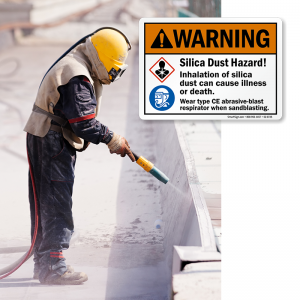
Abrasive blasting is the process of directing a high-velocity stream of abrasive material at a surface to remove paint, rust, scale, or chemical buildup. Common abrasive media include sand, glass beads, garnet, steel grit, dry ice, and sodium bicarbonate (baking soda). It is widely used in construction, shipbuilding, industrial maintenance, automotive refinishing, and infrastructure restoration.
Abrasive blasting is also one of the most hazardous industrial operations a worker can perform. Hazards include permanent lung disease from silica dust, irreversible hearing loss from blast noise, and toxic substance exposure when stripping lead-based paint or heavy-metal-containing coatings. Without proper controls, the health consequences for workers can be severe and permanent.
Abrasive blasting operations in general industry are governed primarily by OSHA 29 CFR 1910.94, with additional requirements under the respiratory protection, noise, lead, and silica standards.
Key health hazards of abrasive blasting
1. Silicosis and respiratory disease
The most serious and life-threatening hazard of abrasive blasting is silicosis, a progressive and incurable lung disease caused by inhaling fine particles of respirable crystalline silica (RCS). When silica-containing abrasives such as sand shatter on impact during blasting, they release microscopic silica particles that penetrate deep into lung tissue, causing irreversible scarring and loss of lung function.
Three forms of silicosis are recognized based on exposure level and duration:
| Type | Exposure Pattern | Onset |
|---|---|---|
| Chronic silicosis | Long-term low-to-moderate exposure | 10 or more years after first exposure |
| Accelerated silicosis | Moderate-to-high exposure | 5 to 10 years after first exposure |
| Acute silicosis | Short-term very high exposure | Weeks to 5 years after exposure |
OSHA and NIOSH both recognize silicosis as a leading occupational lung disease among blasting workers. NIOSH recommends eliminating silica sand as a blasting abrasive entirely and substituting lower-hazard alternatives.
OSHA permissible exposure limit (PEL) for respirable crystalline silica: 50 micrograms per cubic meter (50 µg/m³) as an 8-hour time-weighted average, per 29 CFR 1910.1053.
2. Noise-induced hearing loss
Abrasive blasting generates sustained noise levels that routinely exceed OSHA’s 90 dBA permissible exposure limit for an 8-hour shift. Repeated exposure to blast noise causes permanent noise-induced hearing loss (NIHL), which has no medical treatment or reversal.
Hearing loss risk in blasting areas is not limited to the operator. Workers in the vicinity of an active blasting operation are also exposed to hazardous noise levels and must be included in hearing protection programs.
Under OSHA 1910.95, a hearing conservation program is required whenever workers are exposed to noise at or above 85 dBA as an 8-hour time-weighted average. This program must include noise monitoring, audiometric testing, hearing protection, and worker training.
3. Toxic substance exposure: lead, cadmium, and heavy metals
A significant secondary hazard arises when abrasive blasting is used to remove coatings that contain toxic substances. Two hazards are relevant here:
Coatings being removed: When blasting removes lead-based paint or coatings containing cadmium, chromium, or other heavy metals, the removed particles become airborne and create a toxic inhalation and surface contamination hazard. Work involving lead-containing coatings must comply with OSHA’s Lead Standard (29 CFR 1910.1025).
The abrasive material itself: Some abrasive blasting media contain trace amounts of toxic substances. Certain grades of recycled industrial slag and some mineral abrasives may contain cadmium, beryllium, or other hazardous components. In these cases, substituting to a cleaner abrasive such as garnet, glass beads, or steel grit is the most effective hazard control.
Before blasting begins, test the surface coating for lead and heavy metals. If hazardous substances are detected, additional controls and medical surveillance obligations apply.

Hierarchy of controls for abrasive blasting hazards
The most effective approach to abrasive blasting safety follows OSHA’s hierarchy of controls, addressing hazards at the source before relying on PPE.
Step 1: Substitution (most effective)
Replace silica sand with a lower-hazard abrasive material. Safer alternatives include:
- Garnet: Natural mineral, low silica content, widely used substitute
- Steel grit and steel shot: Durable, recyclable, suitable for heavy-duty applications
- Glass beads: Non-toxic, produces a smooth finish on metal surfaces
- Aluminum oxide: Hard, angular abrasive for aggressive surface preparation
- Sodium bicarbonate (baking soda): Gentle abrasive for sensitive substrates
- Dry ice (CO2 pellets): Leaves no secondary waste, suitable for food processing environments
- Crushed glass: Produced from recycled glass, lower silica hazard than sand
The selected substitute depends on the base material, the required surface profile, and waste disposal requirements for the specific job.
Step 2: Engineering controls
Engineering controls reduce or eliminate worker exposure without relying on individual behavior or PPE.
Local exhaust ventilation (LEV): Captures dust at or near the blast nozzle before it can disperse into the worker’s breathing zone. Required by OSHA 1910.94 for enclosed or semi-enclosed blasting operations.
Blast enclosures and blast rooms: Contain the blasting operation and the resulting dust within a defined, controlled space.
HEPA vacuum collection: All blasting debris and settled dust must be collected using HEPA-filtered vacuum equipment. Dry sweeping is strictly prohibited because it re-suspends settled silica and toxic dust particles, creating a new inhalation hazard from material that had already been removed from the air.
Wet methods: Applying water to suppress dust at the blast point is an effective supplementary control for outdoor operations.
Step 3: Administrative controls
- Restrict blasting areas to authorized personnel using physical barriers and posted signs.
- Rotate workers to limit the duration of individual exposure to dust and noise.
- Schedule blasting operations during periods when surrounding areas have the lowest occupancy.
- Prohibit eating, drinking, and smoking in blasting areas to prevent ingestion of settled dust.
- Require workers to change out of contaminated clothing before leaving the blasting area.
Step 4: PPE (last line of defense)
PPE for abrasive blasting is required when engineering and administrative controls alone cannot reduce exposures to below permissible limits. It is the last line of defense, not the first.
Required PPE for abrasive blasting operations
The following PPE is required for abrasive blasting operators and must comply with relevant OSHA standards and NIOSH certification requirements.
| PPE Type | Specification | Applicable Standard |
|---|---|---|
| Respirator | NIOSH-approved Type CE supplied-air abrasive blasting respirator | OSHA 1910.134 |
| Head and face protection | Abrasive blasting helmet with integrated face shield | OSHA 1910.135 |
| Eye protection | Integrated into blasting helmet; splash goggles for secondary workers | OSHA 1910.133 |
| Hearing protection | Earplugs or earmuffs rated for blast noise levels | OSHA 1910.95 |
| Gloves | Chemical-resistant gloves (nitrile or neoprene for coatings work) | OSHA 1910.138 |
| Body protection | Full-body coveralls or blast suit to prevent skin contact with abrasive media and toxic dust | OSHA 1910.132 |
| Foot protection | Steel-toed or composite-toed safety shoes or boots | OSHA 1910.136 |
Critical note on respirators: Standard disposable respirators (N95) and half-face air-purifying respirators do not provide adequate protection against the dust concentrations generated during active blasting. A Type CE supplied-air respirator delivers clean breathing air from an uncontaminated source and is the only OSHA-acceptable respirator for blasting operators. See the NIOSH respirator selection guidance for detailed specifications.
OSHA standards applicable to abrasive blasting
Multiple OSHA standards apply simultaneously to abrasive blasting operations. Compliance with one standard does not satisfy the others.
| OSHA Standard | Scope |
|---|---|
| 29 CFR 1910.94 | Ventilation requirements for abrasive blasting |
| 29 CFR 1910.134 | Respiratory protection program and respirator selection |
| 29 CFR 1910.95 | Occupational noise exposure and hearing conservation |
| 29 CFR 1910.1053 | Respirable crystalline silica (PEL: 50 µg/m³ TWA) |
| 29 CFR 1910.1025 | Lead standard (when removing lead-based coatings) |
| 29 CFR 1910.1200 | Hazard communication and SDS for abrasive media |
| 29 CFR 1910.132 | General PPE requirements and hazard assessment |
Safety signs required in abrasive blasting areas
Visible, ANSI Z535-compliant safety signs are a regulatory requirement under OSHA’s hazard communication standards. Workers must be warned at the point of entry, before they encounter any hazard.
Required sign types for abrasive blasting areas include:
- Silica dust hazard warning signs: Notify workers of the silicosis risk and the required respiratory protection before entry.
- PPE requirement signs: Specify which PPE must be worn, including respirator type, hearing protection, eye protection, and gloves.
- Hearing protection required signs: Posted at the perimeter of the noise hazard zone.
- Lead hazard warning signs: Required when removing lead-containing coatings under OSHA 1910.1025.
- Authorized personnel only signs: Restrict access to the blasting area to trained and equipped workers.
- No dry sweeping signs: Reinforce the prohibition on dry sweeping to prevent dust re-suspension.
All signs must be placed before the hazard zone, not inside it, so workers can act on the warning before entering. Signs must be durable and legible under actual site conditions including dust, moisture, and variable lighting.

Abrasive blasting safety compliance checklist
Use this checklist before starting any abrasive blasting operation:
- Coating has been tested for lead, cadmium, and heavy metals before blasting begins.
- Silica sand has been substituted with a lower-hazard abrasive where feasible.
- Local exhaust ventilation or blast enclosure is in place and functioning.
- HEPA vacuum equipment is available for debris cleanup. Dry sweeping materials have been removed from the area.
- Area has been restricted to authorized personnel with physical barriers.
- All operators have a current fit test and medical clearance for the supplied-air respirator.
- All required PPE (Type CE respirator, helmet, hearing protection, gloves, coveralls, safety shoes) has been issued and inspected.
- ANSI Z535-compliant warning signs are posted at all entry points.
- Workers have received training on silica hazards, lead hazards (if applicable), and the hearing conservation program.
- A current Safety Data Sheet (SDS) for the abrasive media is accessible on site.
Frequently asked questions about abrasive blasting hazards
Q : What are the main hazards of abrasive blasting?
A : The three primary hazards are silicosis from inhaling crystalline silica dust, permanent noise-induced hearing loss from blast noise levels that exceed OSHA’s PEL, and toxic substance exposure from lead-based paint and heavy-metal coatings removed during blasting.
Q : What PPE is required for abrasive blasting?
A : Required PPE includes a NIOSH-approved Type CE supplied-air abrasive blasting respirator, a blasting helmet with face shield, hearing protection, chemical-resistant gloves, full-body coveralls, and steel-toed safety shoes.
Q : What is silicosis and how does abrasive blasting cause it?
A : Silicosis is a progressive, incurable lung disease caused by inhaling respirable crystalline silica. During blasting, silica-containing abrasives shatter on impact and release microscopic silica particles. Even brief high-concentration exposure can cause acute silicosis.
Q : Is sand blasting banned by OSHA?
A : OSHA does not outright ban silica sand blasting but strongly discourages it. NIOSH recommends substituting silica sand with safer alternatives such as garnet, glass beads, or steel grit. Where silica sand is used, OSHA’s silica standard (29 CFR 1910.1053) applies in full.
Q : What is the OSHA standard for abrasive blasting?
A : The primary standard is OSHA 29 CFR 1910.94 (ventilation). Additional standards that apply include 1910.134 (respiratory protection), 1910.95 (noise), 1910.1053 (silica), 1910.1025 (lead), and 1910.132 (PPE).
Q : What respirator is required for abrasive blasting?
A : A NIOSH-approved Type CE supplied-air abrasive blasting respirator is required. Standard disposable respirators and half-face APRs do not provide adequate protection during active blasting.
External references and authoritative sources
- OSHA 29 CFR 1910.94: Ventilation for Abrasive Blasting
- OSHA Respirable Crystalline Silica Standard (1910.1053)
- OSHA Lead Standard (29 CFR 1910.1025)
- OSHA Respiratory Protection Standard (1910.134)
- OSHA Occupational Noise Exposure Standard (1910.95)
Related resources on MySafetySign.com
- Abrasive Blasting Safety Signs
- Silica Hazard Warning Signs
- PPE Required Signs
- Hearing Protection Required Signs
- Lead Hazard Warning Signs
- Authorized Personnel Only Signs
- Respirator Required Signs
Category: Resources