

Why Are Safety Vests Required By OSHA?
Being seen on a job site is not just a preference. It is a matter of survival. Struck-by hazards are consistently one of OSHA’s “Fatal Four” leading causes of death in the construction industry. Whether it is a forklift in a warehouse or a sedan speeding through a highway work zone, operators cannot avoid what they cannot see.
While OSHA does not have a single standalone standard for vests in every industry, they vigorously enforce high-visibility clothing requirements through the General Duty Clause and specific construction standards like 29 CFR 1926.651(d). If your workers are exposed to vehicular traffic or heavy equipment, they must be visible.
Compliance relies on adhering to the ANSI/ISEA 107 standard, which defines the level of brightness required based on risk. Learn more about the specific OSHA safety vest requirements for your industry and how to choose the correct class of gear.

What Are Safety Vests?
Safety vests are garments made from fluorescent retroreflective material designed to make the wearer conspicuous in both daylight and low light conditions. They function by creating high contrast against the background environment. When outfitting your crew, you will typically need:

Shop High-Visibility Safety Vests:
3 Reasons Why High-Vis Gear Is Mandatory
OSHA and the Federal Highway Administration (FHWA) mandate these garments because they solve three critical visual problems on the job site.
1. Conspicuity in Complex Backgrounds
A worker wearing a gray shirt stands out against a white wall but disappears against a gray concrete barrier. The Requirement: ANSI/ISEA 107 requires vests to use fluorescent background material (yellow-green or orange-red) that instantly distinguishes the human form from the clutter of construction equipment, dirt, and foliage. This is vital for survey crews and utility workers who often work in areas where the background shifts constantly.
2. Speed-Based Risk Classification (ANSI Classes)
Not all roads are the same. A parking lot attendant faces different risks than a highway paver. The Requirement: High-visibility safety apparel is categorized by “Classes” based on traffic speed and risk.
-
Class 1: For low impact areas where traffic is under 25 MPH (e.g., warehouse delivery drivers).
-
Class 2: Required for working near roadways where traffic exceeds 25 MPH. This is the standard for most construction safety vests.
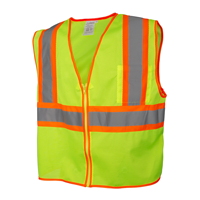
-
Class 3: Mandatory for high risk environments where traffic exceeds 50 MPH or lighting is poor. These vests must have sleeves to provide a full silhouette of the body.

3. Protection from Entanglement
While visibility is the primary goal, safety vests also address mechanical hazards. The Requirement: For workers operating near conveyors or rotating machinery, a standard vest can become a trap. OSHA recommends the use of breakaway safety vests. These feature a 5 point tear away design (shoulders, sides, and front) that allows the vest to rip off instantly if caught in a machine, preventing the worker from being pulled into the gears.
Tips for Maintaining Compliance
-
Check the Label: A vest is only compliant if the tag says so. Ensure every vest you buy has an ANSI/ISEA 107 label stitched inside. If the tag is missing or unreadable, the vest should not be used.
-
Replace When Faded: The sun destroys fluorescent pigment. If the neon yellow vest has faded to a pale yellow or white, it no longer provides the necessary daytime visibility and must be retired immediately.
-
Size Matters: Vests must fit properly. A vest that is too large can snag on equipment, while one that is too tight may not close properly, reducing the amount of visible reflective material.
Incorporate the Right Vests Into Your PPE Program
Visibility is the first line of defense against accidents. By ensuring your team wears the correct Class 2 or Class 3 safety vests, you protect them from distracted drivers and blind spots.
Read through some of the other articles published on our blog to get more expert advice on personal protective equipment and workplace safety standards.
Frequently Asked Questions (FAQ)
1. When does OSHA require a safety vest?
A. When workers are exposed to traffic or heavy equipment. Specifically, OSHA standards require high-visibility clothing for flaggers, excavation workers exposed to vehicular traffic, and any employee working near public roadways. The General Duty Clause also extends this requirement to warehouse workers and heavy equipment operators where visibility is a recognized hazard.
2. What is the difference between Class 2 and Class 3 vests?
A. The amount of reflective material and coverage. Class 2 safety vests are sleeveless and require 201 square inches of reflective tape; they are for traffic speeds under 50 MPH. Class 3 safety vests require 310 square inches of reflective tape and must have sleeves to outline the body. Class 3 is required for high speed traffic (over 50 MPH) and very low light conditions.
3. Can I wear a blue or black safety vest?
A. Only if it is an “Enhanced Visibility” vest, not ANSI compliant. To meet ANSI/ISEA 107 standards for roadway work, the background material must be fluorescent yellow-green, orange-red, or red. A black vest with reflective stripes does not meet the standard for working on public rights-of-way but may be used in private warehouses where ANSI compliance is not legally mandated.
4. How often should safety vests be replaced?
A. Roughly every 6 months to 2 years, depending on use. Vests have a limited service life. Once the fluorescent color fades or the reflective tape becomes cracked and worn, the vest is no longer compliant. Daily wear in the sun will degrade a vest much faster than occasional indoor use.
Category: Uncategorized