

The Complete OSHA Safety Signs Guide
If you’ve ever walked through a warehouse, manufacturing floor, or construction site and instinctively understood that a red-and-white sign meant “serious danger” while a yellow sign meant “watch your step,” then OSHA’s safety sign system is already working on you even if you didn’t realize it.
That’s exactly the point. OSHA’s standardized safety sign system is built so that every worker, regardless of experience level or language, can understand the severity of a hazard at a glance. But for employers, site managers, and safety officers, understanding the system goes beyond reading signs, it means knowing which signs are legally required, what they must look like, where they must be placed, and what happens when they’re missing.
This complete OSHA safety signs guide covers everything you need to know to keep your workplace compliant, your workers informed, and your business protected.
What Is the Legal Basis for OSHA Safety Signs?
OSHA’s requirements for workplace safety signs are codified in two primary regulations:
29 CFR 1910.145 governs general industry manufacturing plants, warehouses, processing facilities, and most commercial workplaces. It establishes design specifications for accident prevention signs and tags, including color requirements and when each sign classification must be used.
29 CFR 1926.200 governs construction covering all job site signage requirements for contractors, builders, and trade workers. It mirrors many of the general industry standards but includes additional rules specific to construction environments.
Both regulations reference and incorporate the ANSI Z535 standard, which is published by the American National Standards Institute. ANSI Z535 goes into far greater detail than OSHA’s regulations alone, specifying precise color values, text formatting, symbol usage, and pictogram design. While ANSI standards are technically voluntary, OSHA’s direct reference to them in federal regulations effectively makes them part of the compliance requirement.
Put simply: to be OSHA-compliant, your safety signs generally need to follow ANSI Z535 specifications.
OSHA Safety Sign Classifications
The foundation of OSHA’s safety sign system is the signal word, a single word placed prominently on the sign that immediately communicates the severity of the hazard. OSHA and ANSI recognize five primary signal words, three of which relate to direct hazard warnings.
DANGER
Color: Red background with white text (upper panel); black border; white lower panel for additional messaging.
The word DANGER indicates the most serious level of hazard, a situation where death or severe injury is almost certain if the hazard is not avoided. OSHA’s 29 CFR 1926.200 is explicit: Danger signs shall be used only where an immediate hazard exists. They are not for “possible” or “potential” hazards only imminent ones.

Common examples include high-voltage, electrical panels, exposed energized conductors, arc flash zones, confined spaces with immediately dangerous atmospheres, and chemical areas with lethal exposure risk. If you’re managing any area with live electrical equipment, Danger signs are almost certainly required, and they must meet the red-black-white color specification exactly as OSHA does not permit color modifications.
WARNING
Color: Orange background with black text and the safety alert symbol (triangle with exclamation point).
WARNING sits between DANGER and CAUTION in severity. It signals a hazard that could result in death or serious injury, but where the overall risk level doesn’t rise to “imminent” or “almost certain.” This makes it the appropriate classification for many common industrial hazards: overhead crane operations, machine warnings, moving equipment in shared pedestrian areas, equipment with serious pinch or crush points, and electrical work areas that are controlled but not immediately life-threatening.

OSHA Warning Sign – Keep Hands Clear Of Moving Machinery Sign
The safety alert symbol is an exclamation mark inside an equilateral triangle which must precede the signal word on Warning signs, just as it does on Danger and Caution signs.
CAUTION
Color: Yellow background with black text panel and black lettering.
CAUTION signs signal potential hazards or unsafe practices that could cause minor to moderate injury if not avoided. These are the workhorses of everyday workplace safety communication, slippery floors, low overhead clearance, pinch points on machinery, areas requiring PPE, and similar hazards that pose real risk but not a life-threatening one.
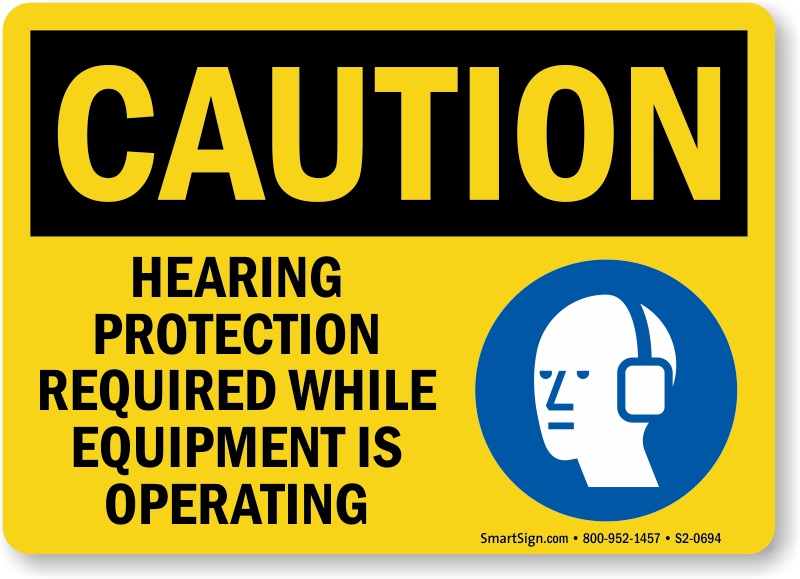
Hearing Protection Required While Equipment Operating Sign
A critical distinction: OSHA’s regulations state that Caution signs shall be used only to warn against potential hazards or unsafe practices. Using a Caution sign for a hazard that truly warrants a Danger or Warning classification is a compliance violation in itself, it understates the risk and gives workers a false sense of the danger level.
NOTICE
Color: Blue background with white text; no safety alert symbol used.

Safety Glasses, Safety Shoes Required Beyond This Point Sign
Notice signs are not hazard warnings, they convey important procedural, operational, or policy information that is unrelated to personal injury risk. Examples include “Notice: Authorized Personnel Only,” “Notice: Hard Hat Required Beyond This Point,” or “Notice: Equipment Shutdown Procedure.” While they don’t warn of a physical hazard directly, Notice signs are often critical to safe workplace operations and must still follow OSHA and ANSI formatting standards.
SAFETY INSTRUCTIONS / GENERAL SAFETY
Color: White background with green upper panel and white lettering; additional text in black on the white background.

First Aid Station Sign with Down Arrow
These signs provide broad safety-related information, first aid station locations, fire exit directions, PPE requirements, emergency procedures, and housekeeping guidelines. They don’t warn of a specific hazard but contribute to the overall safety culture and awareness of a facility.
The Special Classifications: Biohazard and Fire Safety Signs
Beyond the five standard signal words, OSHA mandates specific signage for two additional hazard categories.
Biohazard signs are required wherever biological hazards may be present. Per OSHA’s Bloodborne Pathogens standard (29 CFR 1910.1030), biohazard signs and labels must be fluorescent orange or orange-red, with lettering and symbols in a contrasting color, and must include the word “BIOHAZARD” along with the universal biohazard symbol. These must be posted in HIV and HBV research laboratories, on containers used to store or transport potentially infectious materials, and in any area where occupational exposure is possible.
Fire safety signs identify fire exits, emergency egress routes, fire extinguisher locations, and areas where fixed fire suppression agents could pose health hazards. OSHA also requires employers to post signs in any area where the agents used in fixed extinguishing systems such as halon or CO2 , could be hazardous to workers who might enter the area during or after system activation.
OSHA Safety Sign Design Requirements: What Every Sign Must Have
Beyond the signal word and color, OSHA specifies several universal design requirements that apply to all safety signs:
Rounded or blunt corners. All signs must have rounded or blunt corners with no sharp edges, burrs, splinters, or projections. This seemingly minor requirement exists because workers often handle signs during installation or emergencies, a sharp metal edge can cause a laceration during an already stressful situation.
Safe fastening devices. Any hardware used to mount or hang a sign must be positioned so it doesn’t present its own hazard.
Legibility. Signs must be readable under the lighting conditions of the area where they’re posted. In low-light environments electrical rooms, underground utilities, night shift operations, reflective or illuminated signs may be required to meet this standard.
Durable materials. Sign materials must be appropriate for the environment. Outdoor signs require weatherproof materials. Signs in chemical environments must resist exposure to the chemicals present. Signs on high-traffic equipment must withstand vibration and impact. For most permanent installations, aluminum signs are the industry standard for durability and weather resistance. For temporary or frequently updated signs, corrugated plastic or vinyl are appropriate choices.
Consistent, accurate wording. OSHA’s wording requirements are straightforward: sign text must be easy to read, accurate, sufficient in detail, concise, and where possible, state a positive action. “Keep Door Closed” is preferable to “Do Not Leave Door Open.” This positive phrasing is a small detail that actually improves compliance instructions stated as actions are processed faster than prohibitions.
Bilingual signage where required. If your workforce includes employees who don’t read English, your safety communication must reach them too. OSHA’s General Duty Clause requires employers to provide a workplace free from recognized hazards, and a safety sign in a language a worker cannot read is not fulfilling its safety function. Bilingual signs English and Spanish being the most common are available for virtually every sign category and are particularly important in construction, agriculture, and manufacturing.
ANSI Z535: The Standard Behind the Standard
While OSHA sets the baseline, the ANSI Z535 series is where the detailed specifications live. The most relevant documents for workplace signage are:
ANSI Z535.1 Safety Color Code: Defines the exact color values for each hazard classification. OSHA prohibits modifying safety sign colors, and Z535.1 provides the precise specifications that “red” and “yellow” actually mean in practice, ensuring that a Danger sign looks the same across every manufacturer and every facility.
ANSI Z535.2 Environmental and Facility Safety Signs: The primary standard for workplace signs, covering signal words, design layout, safety symbols, and text formatting requirements.
ANSI Z535.5 Safety Tags and Barricade Tapes: Governing the design and use of temporary warning tags, the hang tags used during lockout/tagout procedures and similar temporary hazard communication.
ANSI last updated the Z535 standard in 2017. While replacing older signs with the updated standard is currently voluntary, OSHA strongly encourages compliance with the latest version to minimize confusion between older sign formats and newer ones particularly in facilities that have been in operation for many years and may have a mix of old and new signage.
Sign Placement Rules: Where OSHA Requires Signs to Go
Knowing which sign to use is only half the equation, OSHA also specifies where and how signs must be posted.
29 CFR 1910.145(f)(3) states that signs “shall be used as a means to prevent accidental injury or illness to employees who are exposed to hazardous or potentially hazardous conditions, equipment, or operations which are out of the ordinary, unexpected, or not readily apparent.”
29 CFR 1910.145(f)(4)(vi) adds that signs must be placed “as close as safely possible” to the hazard. This means positioning the sign where a worker will encounter it before they encounter the hazard itself, not on the hazard itself, not ten feet past the danger zone, but at the point of approach where the warning can actually influence behavior.
Additional placement rules include:
- Signs must be posted at eye level where possible, ensuring they’re in the natural sightline of workers approaching the area.
- Signs and symbols must be visible at all times during work operations.
- Signs must be removed or covered promptly when the hazard no longer exists. Leaving outdated or irrelevant signs posted is a compliance violation and it erodes the effectiveness of all signage in the facility, as workers learn to tune out signs they believe are never updated.
- In areas with multiple hazards, each hazard must have its own appropriate signage. A single “Danger” sign at the entrance of an area doesn’t cover every individual hazard within that area.
Electrical Safety Signs: A Category That Demands Special Attention
Electrical hazards represent one of the most critical sign categories in any workplace and one of the most strictly regulated. Electrocutions are consistently among the top causes of fatal workplace accidents, and proper electrical safety signage is a central component of OSHA’s electrical standards.
At Electrical Panels and Switchgear: Danger signs indicating high voltage must be posted on all electrical panels, transformers, and switchgear. NFPA 70E (the electrical safety standard that OSHA references) additionally requires arc flash hazard labels that specify the incident energy rating, required PPE category, working distance, and the available fault current. These labels go beyond a simple Danger sign, they give qualified workers the specific information they need to work safely around energized equipment.
At Lockout/Tagout Points: Any equipment with energy isolation points, circuit breakers, valve handles, pneumatic shutoffs must have Lockout/Tagout Required signs or labels directing workers to follow proper energy control procedures before servicing. These signs should be permanently affixed to the equipment, not just posted when work is being done.
At Restricted Access Areas: Unauthorized workers must be directed away from electrical work areas with “Authorized Personnel Only” and “Electrical Hazard Keep Out” signage. The boundary of the restricted area must be signed, not just the equipment itself.
At Overhead Power Lines: When work is being performed near overhead electrical lines, Danger signs specifying the required clearance distance must be posted at the approach to the area.
On Temporary Power Equipment: Spider boxes, temporary distribution panels, and generators used on job sites all require appropriate hazard signage too often an afterthought on construction sites where temporary power is treated as low-priority infrastructure.
OSHA Safety Sign Compliance: A Practical Checklist
Use this checklist to audit your current signage compliance:
Identification
- All workplace hazards have been identified through a formal hazard assessment
- Each hazard has been classified by severity (Danger / Warning / Caution / Notice)
- The correct signal word is being used for each hazard level
Design
- Signs use the correct OSHA/ANSI-specified colors for their classification
- All signs have rounded or blunt corners with no sharp edges
- Sign text is concise, accurate, and states a positive action where possible
- Symbols and pictograms are ANSI Z535 compliant
- Bilingual signs are in use where the workforce requires them
Materials
- Outdoor and weather-exposed signs are made from weatherproof materials
- Chemical area signs are made from chemical-resistant materials
- Signs in high-traffic equipment areas are impact-resistant
Placement
- Signs are positioned at the point of approach before the hazard, not at it
- Signs are at or near eye level
- Signs are visible under existing lighting conditions (reflective signs used where needed)
- Outdated signs have been removed or covered
- Each individual hazard is marked, not just the entry to a multi-hazard area
Electrical Specific
- All electrical panels have OSHA Danger and NFPA 70E arc flash labels
- Lockout/Tagout Required signs are permanently affixed at all energy isolation points
- Restricted electrical areas are signed at the boundary perimeter
- Overhead power line approach areas are signed with clearance distances
What Happens When OSHA Safety Signs Are Non-Compliant?
OSHA has enforcement authority to inspect workplaces, issue citations, and levy fines for signage violations. Penalties are categorized by severity:
Other-than-serious violations where the hazard is unlikely to cause serious injury can result in fines up to $16,550 per violation.
Serious violations where there’s substantial probability that the violation could cause death or serious physical harm carry the same maximum penalty, but OSHA typically penalizes these more aggressively.
Willful or repeat violations where an employer knew about the problem and failed to fix it, or has been cited for the same issue before can result in fines up to $165,514 per violation.
Beyond OSHA fines, non-compliant or missing signage creates significant legal exposure in the event of an injury. If an investigation reveals that a worker was hurt by a hazard that was not properly communicated through compliant signage, that becomes a central issue in any subsequent workers’ compensation claim or personal injury lawsuit.
The cost of a properly signed workplace is a fraction of the cost of a single serious incident.
Choosing the Right Sign Material for Your Application
MySafetySign.com offers OSHA-compliant safety signs in multiple materials, and choosing the right material for the application matters as much as choosing the right sign.
Aluminum is the most durable option and the standard for permanent outdoor or industrial installations. Rust-proof and weather-resistant, aluminum signs hold up in the harshest conditions like UV exposure, temperature extremes, chemical environments, and heavy-use areas. For electrical panels, equipment labeling, and long-term outdoor hazard communication, aluminum is the go-to choice.
Rigid Plastic (Plastic/Fiberglass) offers a cost-effective option for semi-permanent indoor installations. Lighter than aluminum and resistant to most cleaning chemicals, plastic signs are ideal for warehouses, production floors, and indoor utility areas.
Vinyl provides flexibility for irregular surfaces, equipment labeling, and temporary applications. Vinyl signs can be applied directly to equipment, walls, doors, and machinery where rigid signs aren’t practical.
Corrugated Plastic (Coroplast) is the standard for temporary or frequently relocated signage like construction sites, event areas, and seasonal hazard communication. Lightweight and inexpensive, corrugated plastic signs can be staked, hung, or zip-tied to fencing and barricades.
Final Thoughts: OSHA Safety Signs Are an Investment, Not a Checkbox
The temptation in any compliance exercise is to treat it as paperwork and get the minimum number of signs to technically satisfy the regulation and move on. That approach misses the entire point.
OSHA’s safety sign system exists because properly communicated hazard information saves lives. The red-and-white Danger sign on a high-voltage panel isn’t a bureaucratic requirement, it’s the thing that makes a new electrician pause before touching something that could kill them. The arc flash label isn’t optional documentation, it’s the information a qualified worker needs to select the right PPE before opening that panel.
1. When should I choose Aluminum over Rigid Plastic or Vinyl? Material choice depends on the environment and duration.
- Aluminum: Use for permanent outdoor hazards or high-heat areas. It is rust-proof and survives UV exposure without becoming brittle.
- Rigid Plastic: Ideal for indoor “Notice” or “General Safety” signs in warehouses.
- Vinyl (Decals): Best for curved surfaces, like chemical drums or curved machinery guards, where a rigid sign won’t stick.
2. Why can’t I use “Safety Orange” for a Danger sign?OSHA and ANSI specifya very strict Safety Color Code (ANSI Z535.1) to prevent “warning confusion.”
- Red is reserved for DANGER (imminent death).
- Orange is reserved for WARNING (serious injury/death possible, but not “imminent”). Using the wrong color can lead to a worker misjudging the response time needed to stay safe, which is a significant compliance violation.
3. Do I need “Retroreflective” signs for my site?If your facility or construction siteoperates during night shifts or in low-light areas (like basements or tunnels), the answer is yes. Standard signs are invisible in the dark. Retroreflective materials bounce light from flashlights or headlamps back to the worker, ensuring the “Signal Word” is readable even when the power goes out.
4. What is the “Positive Action” wording rule for sign materials?When designing or ordering custom signs, OSHA recommendsstating a positive action rather than a prohibition. For example, a sign made to say “Keep Area Clear” is more effective than “No Parking.” Human brains process “what to do” faster than “what not to do” during an emergency.
5. How do I prevent my signs from becoming a “secondary hazard”?The material and placement must not create a new danger.
- Sharp Edges: All metal signs must have rounded or blunt corners.
- Fasteners: Use recessed screws or plastic zip-ties that don’t protrude into walkways.
- Height: Mount signs between 4 to 6 feet (eye level) to ensure they aren’t a trip hazard if they become loose or fall.
Category: Uncategorized