

What Colors Are Used for Electrical Safety Signs?
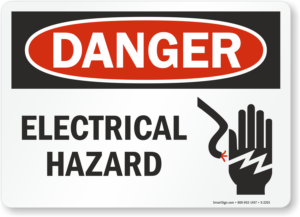
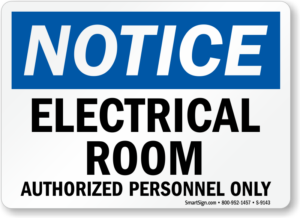
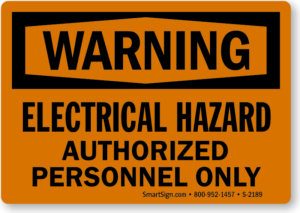
Electrical safety signs use four primary colors under OSHA and ANSI standards: red for immediate danger, orange for serious warning, yellow for caution, and blue for notices and PPE requirements. Each color maps to a specific hazard severity level and appears in a fixed combination with its signal word. Using the wrong color on an electrical sign is not just a design error. It is a compliance failure that can result in an OSHA citation and, more critically, leave workers without accurate hazard information at the moment they need it most.

The Electrical Safety Sign Color System
Here is the complete color system as it applies to electrical safety signs, with the required design format and common electrical applications for each:

Why Color Communicates Faster Than Words
A worker approaching an electrical panel sees color before they read a single word. Red registers as stop-level danger in under 150 milliseconds, before the brain has processed any text. This is why OSHA’s color requirements under 29 CFR 1910.145 and ANSI’s system under ANSI Z535.1 are non-negotiable. The color is not decorative. It is the first layer of hazard communication, and it works even when lighting is poor, the worker is moving quickly, or language barriers make text unreliable.
This also explains why substituting colors is never acceptable. An orange sign where a red one belongs tells a worker the hazard is serious but survivable with care. A red sign communicates immediate life threat. In an electrical environment where the difference between 120V and 480V can mean the difference between a shock and a fatality, that color distinction is not a formality.

Arc Flash Signs: A Special Case
Arc flash hazard signs follow the standard red and orange color system above, but they carry additional required content under NFPA 70E (Standard for Electrical Safety in the Workplace). An NFPA 70E-compliant arc flash warning sign must display the incident energy level in cal/cm², the required arc flash PPE category, the working distance, and the shock hazard voltage. This is a case where customization is not just permitted, it is required by the standard. Every electrical panel with an arc flash hazard needs a sign with the specific energy levels calculated for that equipment, not a generic arc flash warning.
The color on an arc flash sign is typically orange (Warning level) or red (Danger level) depending on the incident energy calculation. Signs with incident energy above 40 cal/cm² are generally posted at Danger level. Signs below that threshold but above the minimum actionable level use Warning level orange.

How Lockout-Tagout Colors Connect
The electrical sign color system extends into lockout-tagout (LOTO) tags as well. Under OSHA 29 CFR 1910.147 and the guidance in ANSI Z535.5, LOTO tags use the same signal word hierarchy: red danger tags indicate equipment must not be operated, orange warning tags indicate hazardous conditions, and yellow caution tags indicate out-of-service equipment awaiting repair. Using consistent colors across both posted signs and LOTO tags reinforces the hazard communication system so workers receive the same visual language whether they are approaching a panel or picking up a tag.
Frequently Asked Questions
Q : What color is a high voltage sign?
A : A high voltage sign uses a red and white color scheme with the signal word DANGER. Red is mandated by OSHA 29 CFR 1910.145 and ANSI Z535.1 for the highest hazard level, where death or serious injury is likely if the hazard is not avoided. The sign typically also displays the electrical shock hazard pictogram (a hand being struck by a lightning bolt) alongside the required voltage level.
Q : Can I use any shade of red or orange on an electrical safety sign?
A : No. OSHA and ANSI Z535.1 specify exact color values for each safety color, referenced against standardized sample chips with defined reflectance criteria. Safety Red, Safety Orange, Safety Yellow, and Safety Blue are precise specifications, not approximate hues. A sign that uses an off-spec shade may appear similar but does not meet the standard and can be cited in an OSHA inspection.
Q : What color is an arc flash warning sign?
A : Arc flash warning signs use orange and black at the Warning signal word level for most calculated incident energy levels, or red and white at the Danger level for high incident energy environments above 40 cal/cm². Under NFPA 70E, the sign must also display specific arc flash boundary data, PPE category, and incident energy value, making every arc flash sign a custom product tied to the specific equipment it is posted on.
Q : Do electrical notice signs need to follow the same color rules?
A : Yes. Electrical notice signs use blue and white as specified by ANSI Z535.1 and ANSI Z535.2. The Notice signal word does not use the Safety Alert Symbol (the exclamation mark in a triangle) because it does not indicate a personal injury risk. Blue electrical signs are typically used for PPE requirement postings (insulated gloves required, safety glasses required) and equipment identification rather than direct hazard warnings.
Need electrical safety signs in the right colors for your facility?
Browse our full range of electrical safety signs including custom arc flash labels, high voltage Danger signs, LOTO tags, and PPE requirement notices in all OSHA and ANSI Z535 compliant colors. Ships fast, free on orders over $29.95.
Category: Uncategorized