

How to inspect scaffolding safety
Scaffolding inspection is the formal, documented assessment of a scaffold’s structural integrity, load capacity, and safety components before and during use. It is required under OSHA 29 CFR 1926.451, the primary federal standard governing scaffold safety in construction.
Scaffolds are one of the most hazardous structures in any construction or maintenance environment. They can collapse due to overloading, structural instability, damaged components, or adverse weather. OSHA estimates that scaffolding accidents result in approximately 4,500 injuries and 60 worker deaths per year in the United States. The majority of these incidents are preventable through regular inspection and proper hazard control.
Key requirement: All scaffolding must be inspected by a qualified competent person before first use, at regular intervals during use, and after any weather event that could affect structural integrity.

When should scaffolding be inspected? (OSHA 29 CFR 1926.451)
OSHA specifies three trigger points at which scaffold inspection is mandatory:
1. After installation and before first use: Every scaffold must be inspected and cleared by a competent person before any worker is permitted to use it, regardless of how recently it was erected or by whom.
2. At least once per week during use: Scaffolding in active use must be inspected on a minimum weekly basis. High-frequency use, heavy loads, or changing site conditions may warrant more frequent inspections.
3. After any adverse weather event: High winds, heavy rain, ice, snow loading, seismic activity, or any other event that could affect the scaffold’s structural integrity requires a fresh inspection before work resumes.
Suspended scaffolds have an additional requirement: Ropes on suspended scaffolds must be inspected by a competent person before each work shift and after any occurrence that could affect the rope’s integrity.
Who is qualified to inspect scaffolding?
OSHA defines the inspector as a competent person, which means someone who:
- Has the knowledge, training, and experience appropriate for the type and complexity of the scaffold being inspected
- Can identify existing and predictable hazards in the surroundings or working conditions
- Has the authority to take prompt corrective action to eliminate identified hazards
The competent person designation is not a formal certification but a combination of demonstrated knowledge and employer-granted authority. A competent person for a simple supported scaffold may not qualify for a complex suspended or specialty scaffold. The inspector’s qualifications must match the complexity of the specific scaffold.
Employers are responsible for designating the competent person and ensuring that individual has the authority to stop work and require corrections when hazards are found.
Scaffolding inspection checklist: what to inspect and how
The following checklist covers all primary scaffold components that must be examined during each inspection. Work through each section systematically before issuing or confirming a scaffold tag.
Section 1: Electrical hazard clearance
- Identify all energized power lines within the work area.
- Confirm all power lines near the scaffold have been de-energized, OR confirm that scaffolding, tools, and materials maintain a minimum 10-foot clearance from any energized line at all times.
- Verify workers are aware of the electrical hazard and clearance requirement.
- Remove or secure any tools or materials that have drifted within the 10-foot exclusion zone.
Section 2: Scaffold base and structural components
- Confirm the scaffold type is appropriate for the intended loads, materials, number of workers, and site weather conditions.
- Inspect footings to verify they are level, sound, rigid, and capable of supporting the fully loaded scaffold without settlement or shifting.
- Confirm all legs, posts, frames, and uprights are seated on baseplates and mudsills.
- Inspect all metal components for:
a) Bends or deformation
B)Holes or cracks
c) Rust or corrosion beyond surface level
d) Pits or mechanical damage
e) Welding splatter on bearing surfaces
f) Broken welds or connections
g) Non-compatible or mismatched parts from different scaffold systems
- Verify that crossbraces are not being used as ladder access. A proper ladder, stairway, or ramp must be in place for safe entry and exit.
Section 3: Planks and decking
Scaffold planks must be scaffold-grade lumber or an approved equivalent. Inspect every plank for the following defects, all of which require the plank to be removed from service:
| Defect | Reject Criterion |
|---|---|
| Cracks or splits | Greater than 1/4 inch in any direction |
| Long end splits | Any length along the end grain |
| Loose knots | Multiple large loose knots in the load zone |
| Warp | Greater than 1/4 inch across the width |
| Grain slope | Greater than 1 in 12 inches from the long edge |
| Mold or rot | Any visible mold, soft spots, or decay |
| Separated laminate | Any delamination on laminated scaffold planks |
| Gouges | Deep surface damage affecting cross-section |
Deflection limit: Any plank that deflects more than 1/60 of the span or 2 inches in a 10-foot span under load is damaged and must be replaced immediately.
Overhang dimensions:
- Planks 10 feet or shorter: must extend 6 to 12 inches beyond the centerline of the end support
- Planks longer than 10 feet: must not extend more than 18 inches beyond the end support
Gap spacing: Planks must be close together with spaces no greater than 1 inch around uprights.
Section 4: Platform
- Confirm the platform is no more than 14 inches from the face of the wall during standard construction work.
- When plastering or stuccoing operations require additional clearance, the platform must be no more than 18 inches from the wall.
- Verify that guardrails and midrails are installed on all open sides and ends of platforms where work is being performed.
- Check for workers positioned beneath the platform and ensure falling object protection is in place: either overhead protection for below-platform workers or barricading to exclude personnel from the drop zone.
- Confirm all platform workers are wearing hard hats and required fall protection.
Section 5: Bracing, tie-ins, and guying
- Confirm that braces, tie-ins, and guying are installed at each end of the scaffold, both vertically and horizontally.
- Verify installation follows the scaffold manufacturer’s instructions for that specific scaffold system.
- Confirm tie-in points are anchored to the building structure, not to temporary fixtures or utilities.
- Check that no tie-ins or braces have been removed or relocated without authorization from the competent person.
Proper bracing and tie-ins prevent tipping, the most catastrophic mode of scaffold failure, and are required regardless of scaffold height.
Scaffold tagging system: green, yellow, and red tags
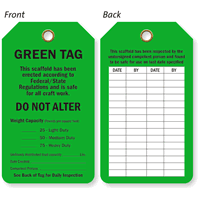
All scaffolds must be tagged after each inspection. The tag must be fastened to the access ladder or near the stairway at eye level where it is easily visible to workers before they begin their ascent. An untagged scaffold must not be used under any circumstances.
Green tag: safe for use
A green scaffold tag indicates the scaffold has been inspected by a competent person and is safe to use as erected. No special precautions or restrictions apply.
Yellow tag: use with caution
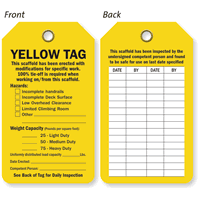
A yellow scaffold tag (caution tag) indicates the scaffold has been modified, is incomplete, or presents a condition that requires special precautions. Key yellow tag rules:
- The specific hazard and required preventive measures must be written on the back of the tag.
- The name of the company representative authorizing use must be recorded on the tag.
- The yellow tag identifies which portion of the scaffold is incomplete, helping the erecting crew track progress.
- A yellow tag must not be removed until the scaffold is fully safe and re-inspected by a competent person.
- After re-inspection, the yellow tag is replaced with either a green tag (safe) or a red tag (unsafe).
Red tag: do not use
A red scaffold tag indicates the scaffold is unsafe for use. No worker may use a red-tagged scaffold until it has been repaired, re-inspected, and re-tagged. Required information on the front of the red tag:
- Work order number or project number
- Inspection date
- Name of the inspector

Common scaffolding hazards and how to prevent them
| Hazard | Primary Cause | Prevention |
|---|---|---|
| Falls from height | Missing or inadequate guardrails | Install guardrails and midrails on all open sides; require fall protection |
| Falling objects | Unsecured tools and materials on platform | Install toeboards; barricade or protect area below platform |
| Structural collapse | Overloading, damaged components, improper assembly | Use competent person inspections; enforce load limits; replace damaged parts |
| Electrocution | Proximity to energized power lines | Maintain 10-foot clearance; de-energize lines before work begins |
| Plank failure | Damaged, defective, or incorrectly graded planks | Inspect every plank before use; use only scaffold-grade lumber |
Required scaffolding safety signs
OSHA’s hazard communication requirements and ANSI Z535 standards require warning signs to be posted at scaffold access points before workers enter the hazard zone. Required sign types include:
- Scaffold inspection required signs: Remind workers to check for a current green tag before ascending.
- Fall protection required signs: Posted where fall hazards are present on or below the scaffold.
- Hard hat required signs: Required in areas where falling object hazards exist.
- Authorized personnel only signs: Restrict scaffold access to trained and equipped workers.
- Do not use this scaffold signs: Post at untagged or red-tagged scaffolds to prevent unauthorized use.
- Maximum load capacity signs: Display the rated load limit on or adjacent to the scaffold.
All signs must be ANSI Z535-compliant with the appropriate signal word (DANGER, WARNING, or CAUTION), relevant pictogram, and clear instructional text.
Scaffolding inspection compliance checklist
Use this checklist before each scaffold inspection is closed out and the tag is applied.
Electrical hazards
- Power lines de-energized or 10-foot clearance confirmed
- No tools or materials within 10-foot exclusion zone
Base and structure
- Scaffold type appropriate for load and conditions
- Footings level, sound, and stable
- All legs and uprights on baseplates and mudsills
- Metal components free of bends, cracks, rust, and incompatible parts
- Proper ladder or stairway access in place; crossbraces not used as ladder
Planks
- All planks are scaffold-grade lumber or equivalent
- No planks with splits, cracks, mold, warps, or grain defects beyond limits
- Overhang dimensions within required range
- Gap between planks no greater than 1 inch at uprights
- No plank deflecting more than 1/60 of span under load
Platform
- Distance from wall within 14-inch limit (or 18 inches for plastering work)
- Guardrails and midrails installed on all open sides where work is performed
- Falling object protection in place for workers below platform
- Workers wearing hard hats and fall protection
Bracing
- Braces, tie-ins, and guying installed at each end, vertically and horizontally
- Installation matches scaffold manufacturer’s specifications
Tagging
- Appropriate tag (green, yellow, or red) applied at eye level on access ladder or stairway
- Inspection date and inspector name recorded on tag
- Required information (hazard description, authorizing name) on yellow tag back if applicable
Frequently asked questions about scaffolding inspection
Q : When should scaffolding be inspected according to OSHA?
A : Per OSHA 29 CFR 1926.451, scaffolding must be inspected after installation and before first use, at least once per week during active use, and after any adverse weather event that could affect structural integrity.
Q : Who is qualified to inspect scaffolding?
A : Inspections must be performed by a competent person with the knowledge, training, and experience for the specific scaffold type, and who has the authority to take immediate corrective action.
Q : What does a scaffold green tag mean?
A : A green tag indicates the scaffold has been inspected and is safe for use without restriction.
Q : What does a scaffold yellow tag mean?
A : A yellow caution tag indicates the scaffold has been modified or is incomplete and presents conditions requiring special precautions. The hazard and required measures are documented on the back. The yellow tag must not be removed until the scaffold is fully safe and re-inspected.
Q : What does a scaffold red tag mean?
A : A red tag means the scaffold is unsafe and must not be used. It must display the work order number, inspection date, and inspector name.
External references and authoritative sources
- OSHA 29 CFR 1926.451: General Requirements for Scaffolds
- OSHA 29 CFR 1926.452: Additional Requirements for Specific Types of Scaffolds
- OSHA Scaffolding Safety Topic Page
- OSHA Scaffolding eTool
- ANSI/ASSE A10.8: Scaffolding Safety Requirements
Related resources on MySafetySign.com
- Scaffold Inspection and Safety Signs
- Fall Protection Required Signs
- Hard Hat Required Signs
- Authorized Personnel Only Signs
- Do Not Use This Scaffold Signs
- Construction Safety Signs
Category: Electrical