

Is Bilingual Signage Required by Law?
OSHA does not have a blanket rule that explicitly says, “You must post every sign in English and Spanish.” However, if you have employees who do not speak English, posting signs only in English is a fast track to a compliance violation and, more importantly, a safety hazard.
The “Understandable” Rule While the text of the law might not specify a language, OSHA’s requirements are clear about the result. According to OSHA standard 1910.145, safety instructions must be “understandable to all employees.”
If a significant portion of your workforce speaks Spanish, Vietnamese, or another language, and you only provide safety warnings in English, you have failed to warn them effectively. In the eyes of an inspector, an incomprehensible sign is often treated the same as having no sign at all.
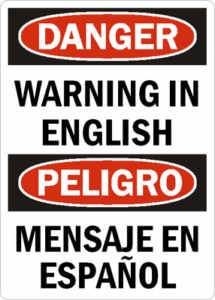
Why You Should Go Bilingual Anyway Even if you aren’t strictly “required” by a specific local statute, bilingual signage is a best practice that pays off.
- Accident Reduction: Workers who fully understand safety protocols are less likely to be injured.
- Inclusivity: It shows you respect your workforce and care about their well-being, regardless of their native tongue.
- ANSI Standards: The American National Standards Institute (ANSI) strongly encourages the use of symbols and multiple languages to bridge communication gaps.
The Power of Symbols One of the best ways to meet the “understandable” requirement is to use ANSI-compliant signs that feature standard symbols (like the “prohibited” circle with a slash or the yellow “caution” triangle). Symbols are a universal language that reinforces the text, ensuring the message lands immediately.
Bottom Line Don’t wait for an accident or an inspection to upgrade your facility. If your team speaks it, your signs should say it.
MySafetySign carries a massive inventory of bilingual safety signs and customizable templates to help you keep every worker in the loop.
Category: Bilingual