

Warehouse Safety Signs Guide for Facility Managers
The modern warehouse is a dynamic, high-stakes environment, a complex ecosystem of heavy machinery, moving personnel, and critical inventory. For the facility manager, ensuring the seamless flow of operations is inextricably linked to maintaining uncompromising safety. In this context, safety signs are not just decorative; they are administrative controls, the silent, ever-present stewards of compliance, liability reduction, and accident prevention.
Understanding and correctly implementing industrial signage is the single most cost-effective investment a facility manager can make to protect their workforce and their company’s bottom line. Failure to comply with OSHA and ANSI standards exposes the organization to massive fines, litigation, and, most importantly, the catastrophic human cost of workplace injury.
This comprehensive guide delves into the essential safety sign categories, detailing the regulatory imperative and the best practices for placement and material selection to create a truly secure working environment.
The Regulatory Imperative: Why Standards Govern Signage
Before selecting signs, a facility manager must grasp the regulatory framework: the Occupational Safety and Health Administration (OSHA) mandates what must be marked, and the American National Standards Institute (ANSI Z535) dictates how a warning must be communicated.
This means you cannot simply print a warning; it must adhere to strict guidelines regarding color, format, and header signal words:
- DANGER (Red, White): Indicates an imminently hazardous situation that, if not avoided, will result in death or serious injury. Reserved for the most extreme hazards.
- WARNING (Orange, Black): Indicates a potentially hazardous situation that, if not avoided, could result in death or serious injury. Used for serious risks that are not always immediate.
- CAUTION (Yellow, Black): Indicates a potentially hazardous situation that, if not avoided, may result in minor or moderate injury. Used to mark less severe hazards.
- NOTICE (Blue, White): Used for non-hazard messages, such as property protection, equipment status, or procedural instructions (e.g., “Visitor Registration”).
A specialized safety sign provider, MySafetySign.com, ensures every sign you order meets these complex color-coding and formatting requirements, guaranteeing immediate regulatory compliance.
Essential Sign Categories for Compliance and Risk Reduction
A compliant warehouse requires comprehensive signage across six high-priority categories:
1. Emergency Exit and Evacuation Signs
Why It’s Critical: In an emergency, panic and confusion are the greatest threats. Clear, consistent emergency signage is directly tied to life safety, ensuring personnel can quickly locate and utilize evacuation routes. OSHA requires clear marking of all exits.
Must-Have Signs:
- Emergency Exit signs, often required to be illuminated or photoluminescent (glow-in-the-dark) to remain visible during power outages.
- Evacuation Route Maps posted prominently near entrances and break rooms, showing “You Are Here.”
- Assembly Point markers outdoors, indicating a safe post-evacuation gathering location.
- Fire Extinguisher location markers and directional arrows to fire equipment.
Best Practice: Do not allow any physical obstruction (boxes, equipment, pallets) within three feet of an emergency exit sign. For maximum visibility, ensure the sign material itself is high-contrast and durable plastic or aluminum suitable for interior walls and exterior collection points.
2. Forklift and Vehicle Traffic Signs
Why It’s Critical: Forklifts (Powered Industrial Trucks) are involved in a significant percentage of warehouse accidents, many of which involve pedestrians. Traffic signs are essential to create and enforce separate traffic flows for machines and personnel.
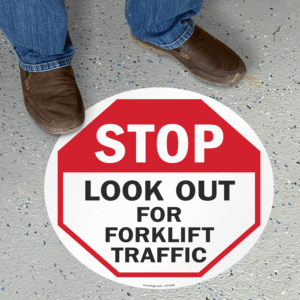 Must-Have Signs:
- Speed Limit signs (usually 5-10 mph within the facility) to control vehicle momentum.
- Pedestrian Walkway and Forklift Crossing signs to clearly delineate shared zones.
- Yield or Stop signs at blind intersections, rack corners, and aisle crossings.
- Caution: Overhead Load warnings near staging areas and loading zones.
Best Practice: Combine vertical traffic signs with durable floor marking tape or painted lanes. Installing convex mirrors at blind corners and supplementing with “Look Both Ways” signs significantly reduces the risk of collision.
3. Personal Protective Equipment (PPE) Signs
Why It’s Critical: PPE is the last line of defence against workplace hazards. Requirements change by activity (welding, cutting, chemical mixing). Signs must clearly communicate the mandated equipment before a worker enters the restricted zone.
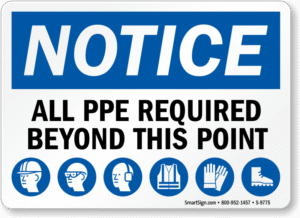
Must-Have Signs:
- Signs mandating Hard Hat Required (especially under racks or near cranes).
- Signs requiring Safety Glasses Required (in machining or cutting areas).
- Signs requiring Hearing Protection Required (near compressors or high-decibel machinery).
- Signs requiring Steel-Toe Boots Required (in loading docks and material handling areas).
Best Practice: Utilize the ANSI Z535 format, which combines the header (e.g., NOTICE) with a recognizable pictogram for instant understanding, regardless of the worker’s native language. Place these signs at the point of entry to the hazard zone, not inside it.
Why It’s Critical: Misidentification of chemicals is an enormous safety and legal liability. Proper identification protects workers from exposure and guides emergency responders on how to handle spills or fires, adhering to OSHA’s Hazard Communication Standard.
Must-Have Signs:
- NFPA Diamond labels on chemical storage rooms, indicating fire risk, health risk, instability, and specific hazards.
- GHS pictograms on individual containers, detailing the nature of the chemical risk (flammable, corrosive, toxic).
- Caution: Chemical Storage and Safety Data Sheets (SDS) Location signs.
- Signs mandating specific PPE for handling (e.g., Gloves Required).
Best Practice: Ensure all hazardous material signs and labels are chemical-resistant and highly durable. The accompanying SDS sheets must be accessible within 10 seconds of an employee requesting them, and this location should also be marked with a dedicated sign.
5. Loading Dock and Pit Safety Signs
Why It’s Critical: Loading docks are high-risk interfaces where trucks, forklifts, products, and personnel interact, often dealing with significant height differences and heavy weights. Accidents here can be catastrophic.
Must-Have Signs:
- Dock Edge Warning signs (often paired with high-contrast floor marking).
- Height Clearance indicators to prevent trucks and forklifts from hitting overhead doors.
- Wheel Chocks Required reminders for truck drivers before loading/unloading operations begin.
- “Stand Clear of Dock Leveler” warnings.
Best Practice: Use signs made from rugged aluminum that can handle the repeated vibrations and impacts of a dock environment. For exterior signs, utilize Diamond Grade Reflective Film to ensure maximum visibility for drivers arriving at night or in poor weather.
6. Restricted Area and Electrical Safety Signs
Why It’s Critical: Limiting access to sensitive, expensive, or high-voltage equipment protects both unauthorized personnel and the machinery itself. Violating lockout/tagout (LOTO) procedures is a serious OSHA violation.
Must-Have Signs:
- “Danger: High Voltage” and “Danger: Electrical Hazard”.
- “Authorized Personnel Only” for server rooms, maintenance shops, and chemical storage.
- “Danger: Electrical Panel – Keep Clear” to ensure OSHA-mandated clearance space is maintained.
- “Lockout/Tagout Station” signs.
Best Practice: For electrical panels, use highly visible, self-adhesive vinyl or plastic labels with a protective laminate that resists moisture and grease, ensuring the message stays legible over time.
Beyond the Basics: Durability, Customization, and Procurement
Achieving the 1500-word benchmark of a truly professional facility requires considering the signs themselves, their longevity and adaptability. A cheap plastic sign will fade within months under UV exposure and crack in cold temperatures. Industrial environments demand materials that last:
- Aluminum: Rust-proof, ideal for all outdoor and heavy-duty interior applications.
- High-Density Polyethylene (HDPE) Plastic: Excellent for areas with chemical exposure (like washdown stations) or for temporary signage.
- Reflective Films: Opt for 3M High-Intensity Grade or Diamond Grade reflective films to ensure messages are seen clearly from hundreds of feet away, even at night or in dimly lit corners.
Customization and Communication
Many safety issues are specific to a facility’s unique equipment or procedures. A reputable supplier must offer full customization:
- Bilingual Signs: In facilities with diverse teams, including Spanish or other languages on warning signs is a best practice for immediate understanding and reducing risk.
- Unique Wording: Custom signs allow you to specify instructions like “Do Not Activate Valve 4 Until Clearance Given.”
- Branding and Logistics: Adding your company’s logo can increase employee adherence and present a uniform, professional appearance.
The Strategic Procurement of Safety Signs
Working with a specialist like MySafetySign.com offers critical logistical advantages over general suppliers:
- Expert Compliance Checks: They handle the complex ANSI formatting so you don’t have to.
- Guaranteed Material Quality: Assurance that the signs will perform as advertised under industrial stress.
- Streamlined Ordering: Ability to quickly reorder stock items, and efficient processes for large-volume custom orders, ensuring your compliance needs never create downtime.
Conclusion
The facility manager’s commitment to safety is broadcast through the visibility and quality of their signage. A well-signed warehouse is a safe warehouse, one that minimizes legal exposure, maximizes operational efficiency, and, most importantly, protects every person who walks through its doors.
By meticulously implementing signs from these core categories, focusing on durable materials, and partnering with an expert safety sign provider, you move beyond mere compliance and solidify your status as a manager dedicated to best-in-class industrial safety.
Category: Electrical