

What Lockout Signs Are Required by OSHA?
Unexpected startup of machinery during maintenance is a leading cause of industrial amputations and fatalities. A worker reaches into a press to clear a jam, and a sensor triggers the cycle. A maintenance team repairs a conveyor, but someone in the control room unknowingly flips the switch.
This is why OSHA created the Control of Hazardous Energy standard (29 CFR 1910.147), commonly known as Lockout/Tagout (LOTO). The standard requires that energy sources be physically isolated before work begins.
However, a padlock alone is not enough. You must communicate who locked it and why. Without proper signage and tags, a locked machine is just a mystery that delays production, tempting unauthorized employees to cut the lock. Learn more about the specific signage and tagging requirements that keep your LOTO program compliant and effective.

What Are Lockout Signs?
Lockout signs and tags are visual warnings attached to energy isolation devices (like breakers, valves, or switches). They serve as the legal “voice” of the authorized employee, telling others that the equipment is being serviced and must not be operated. When auditing your energy control program, you will typically need:
Shop Lockout/Tagout Signs:
3 Key Signage Requirements for Compliance
OSHA is very specific about the characteristics of lockout devices. You cannot just use a sticky note or a piece of masking tape.
1. The “Do Not Operate” Tag
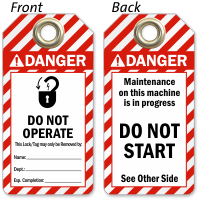
If you are using a lock, you generally must use a tag with it. If a device cannot be locked out, the tag becomes the primary warning. The Requirement: The tag must clearly state a prohibition command, such as “Do Not Operate,” “Do Not Start,” or “Do Not Open.” It must also be durable enough to withstand the environment (wet, dirty, or corrosive) without becoming illegible.
2. Identification of the Authorized Employee
Accountability is the core of LOTO. Only the person who placed the lock is allowed to remove it. The Requirement: The sign or tag must indicate the identity of the employee who applied the device. Most standard LOTO tags have writable fields for “Signed By,” “Date,” and “Department.” This ensures that if a machine needs to be re-energized, the supervisor knows exactly who to contact to verify safety.
3. Energy Source Identification
A complex machine might have four different power sources: electrical, pneumatic, hydraulic, and stored mechanical energy. The Requirement: While not always a specific “sign” on the lock itself, OSHA requires that energy isolation devices be identified. Best practice is to place permanent Lockout Point Labels (e.g., “E-1” for Electrical source 1, “P-1” for Pneumatic source 1) on the machine. These correspond to the written procedure, ensuring the worker locks out the correct valve and not a water pipe by mistake.

Tips for a Robust LOTO System
-
Use Photography: Visual aids reduce error. Create permanent placards for each machine that show a photo of the equipment with arrows pointing to every lockout point.
-
Standardize Your Tags: Do not let employees buy their own tags. The print and format must be standardized within the facility (same color, same shape, same size) so they are instantly recognized as safety devices.
-
Durability Matters: A paper tag on an outdoor generator will disintegrate in the rain. Use sealed vinyl or heavy-duty plastic tags with grommets that can withstand 50 pounds of pull force.
Incorporate the Right Signs Into Your LOTO Procedure
Signs and tags are the final check in the safety chain. They bridge the gap between the written procedure and the physical lock. By ensuring your tags are legible, standardized, and properly filled out, you protect your maintenance team from the terrifying risk of unexpected energy.
Read through some of the other articles published on our blog to get more expert advice on hazardous energy control and OSHA compliance.
Frequently Asked Questions (FAQ)
1. What information must be on a lockout tag?
A. The tag must warn against operation and identify the user. Specifically, it must contain a legend such as “Do Not Start” or “Do Not Operate.” It must also include the name of the authorized employee who applied the device. Many facilities also require the date and the expected duration of the work.
2. Can I use a tag without a lock?
A. Yes, but only if the device is not capable of being locked. If an energy isolating device (like an old valve) has no hasp for a padlock, you may use a “Tagout” system. However, the tag must be attached at the same location a lock would be, and the employer must demonstrate that the tag provides “full employee protection” equivalent to a lock.
3. Do lockout tags need to be weather resistant?
A. Yes, tags must withstand their environment. OSHA requires that tags be capable of withstanding the environmental conditions for the maximum period of time that exposure is expected. For wet or corrosive environments, tags must be made of plastic or vinyl and written with permanent marker so they do not fade or deteriorate.
4. What color are lockout tags?
A. Red, White, and Black is the standard. While OSHA does not dictate a specific hex code, the industry standard follows ANSI Z535 for Danger signs. Most LOTO tags feature a header with a red background, white text (“DANGER”), and a white body with black text for the instructions and user information.
Category: Electrical